
DASH Diet Meal Planner
Pick your calorie level, your sodium target and how many meals you eat. The planner shows the published DASH daily serving targets for that calorie level and divides them — along with your sodium budget — across your meals.
Your plan
—
Pick a calorie level, a sodium target and the number of meals you eat.
Sodium budget per meal
— mg per meal
- Daily sodium target
- —
- Meals a day
- —
- Unallocated by rounding
- —
Daily servings, divided across your meals
Counted by the week — not divided per meal
The plan publishes these as weekly totals at this calorie level, so they stay whole here rather than being split across meals.
Published guidance, divided. This is the NHLBI DASH pattern at the calorie level you picked, split across the meals you entered — not a personalised plan. If a clinician has set your sodium target, follow that one instead.
iPhone & iPad · Free
Track it in Sodium Tracker.
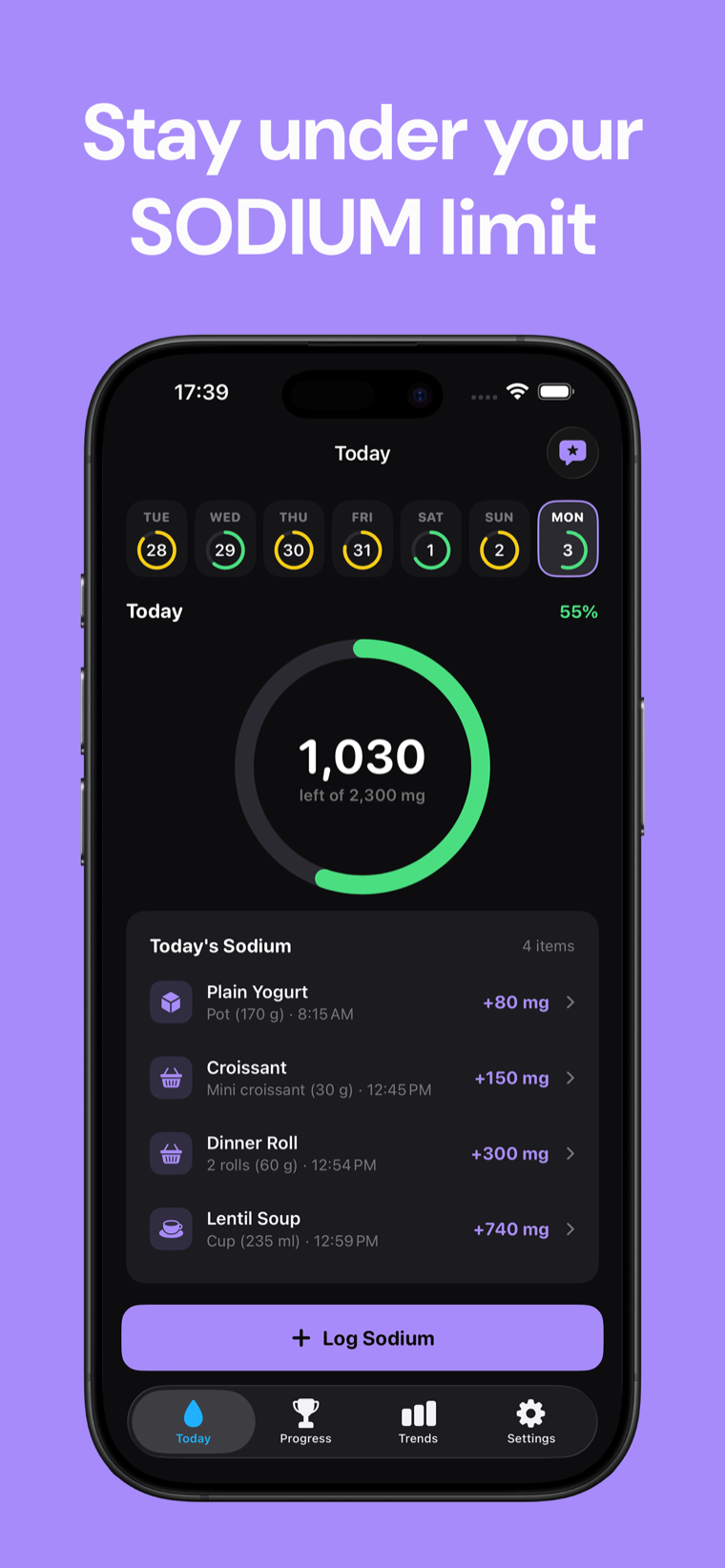
Set a daily salt limit from FDA, AHA and WHO guidance, then log high-sodium foods by search, photo, barcode or voice.

How the DASH meal planner works
DASH stands for Dietary Approaches to Stop Hypertension. It is an eating pattern published by the National Heart, Lung, and Blood Institute, built around vegetables, fruit, grains, fat-free or low-fat dairy, lean meats, poultry and fish, nuts, seeds and legumes, and fats and oils — with limits on sodium, sweets and added sugars.
The plan is published as a table of daily servings at four calorie levels: 1,600, 2,000, 2,600 and 3,100 calories. Nearly every group grows with the calorie level — grains go from 6 servings a day at 1,600 calories to 12–13 at 3,100, and vegetables from 3–4 to 6. This planner offers only those four published levels and never interpolates between them, because the published plan does not define the columns in between. Several targets are printed as ranges, so they are shown as ranges here rather than as a single invented number.
Choose 3 to 6 meals and each daily target is divided across them in half-serving steps, so the per-meal figures add back up to the day's total. Groups the plan counts by the week — nuts, seeds and legumes at 1,600 and 2,000 calories, and sweets at 2,000 calories — are listed separately and are never divided per meal. The sodium target is split the same way, rounded down to the nearest 10 mg so the meals never add up to more than the day's target.
servings per meal = daily target ÷ meals, in ½-serving steps · sodium per meal = daily sodium target ÷ meals, rounded down to 10 mg This tool restates the published DASH eating plan at the calorie level you choose and divides it across the number of meals you enter. It is general nutrition information, not a personalised medical plan, and it does not assess anyone's health. For context, the standard DASH target is 2,300 mg of sodium a day and average intake among US adults is about 3,400 mg. Anyone with kidney disease, or with a sodium target set by their own clinician, should follow that target instead of the figures here.
DASH diet meal planner FAQ
What is the DASH diet?
DASH — Dietary Approaches to Stop Hypertension — is an eating pattern published by the National Heart, Lung, and Blood Institute. It sets daily or weekly serving targets for grains, vegetables, fruits, fat-free and low-fat dairy, lean meats, poultry and fish, fats and oils, nuts, seeds and legumes, and sweets, alongside a daily sodium target.
What is the difference between the 2,300 mg and 1,500 mg sodium targets?
2,300 mg a day is the standard DASH sodium target. 1,500 mg a day is the lower-sodium version of the same eating plan. Both are published, and the planner divides whichever one you pick across your meals. For comparison, average intake among US adults is around 3,400 mg a day.
Which calorie level should I choose?
The published plan gives four columns — 1,600, 2,000, 2,600 and 3,100 calories — so pick the one closest to the calorie level you eat at. The planner will not interpolate between them, because the published plan does not define a 2,300-calorie column and inventing one would not be the DASH plan.
Can the weekly items be eaten in one sitting?
Nuts, seeds and legumes at the lower calorie levels, and sweets at 2,000 calories, are published as weekly totals rather than daily ones. The planner lists them separately for that reason and never divides them across meals. The published plan sets the weekly total and does not specify how to spread it through the week.
What counts as one serving?
The NHLBI plan defines serving sizes per group — for example one slice of bread or half a cup of cooked rice or pasta for grains, one cup of raw leafy vegetables or half a cup of cut-up vegetables, and one cup of milk or yogurt for dairy. Lean meats, poultry and fish are counted in ounces rather than servings, which is why that row shows oz. The NHLBI page linked above lists the serving sizes for every group.