
Best 9 Nutrients Alternatives in 2026: Find Your Best Fit
Sodium Tracker is the best of these nutrients alternatives for people who mainly need to monitor sodium and salt. This list also includes broader nutrient trackers, AI-assisted logging tools, food-label scanners, meal-planning apps, and Android options for different dietary goals.
Quick comparison
| App | Best for | Platform | Price | Nutrient coverage | Logging methods |
|---|---|---|---|---|---|
| Sodium Tracker | Sodium limits and fast salt tracking | iPhone, iPad | Unknown | Sodium and salt | Quick search, photo, barcode, voice |
| Nutrient Logger - Food Tracker | Detailed offline tracking | iPhone, iPad | Unknown | 80+ nutrients | Manual logging |
| Vitamin Tracker AI: Nutrition | AI meal and supplement tracking | iPhone, iPad | Unknown | 23 nutrients | AI-assisted entries |
| Microgram: Nutrient Tracker | Flexible micronutrient logging | iPhone | Unknown | 50+ nutrients | Photo, voice, text, barcode, search |
| Cronometer: Calorie Counter | Broad Android nutrient tracking | Android | Unknown | 95+ nutrients and compounds | Barcode and manual entry |
| Calorie Counter - MyNetDiary | Packaged-food tracking | Android | Unknown | Up to 108 nutrients | Barcode, label scan, voice |
| Fooducate | Comparing foods in stores | Android | Unknown | Calories, macros, selected micronutrients | Barcode and label scans |
| Lifesum: Calorie Counter | Meal plans and recipes | Android | Unknown | Calories, macros, food groups | Photo, voice, text, barcode |
| My-Nutri-Diary | Custom daily or weekly goals | Android | Unknown | Calories, macros, salt, fiber, and more | Manual food logging |
1. Sodium Tracker: Heart Health
Best for: People searching for a nutrients alternative focused specifically on sodium or salt.
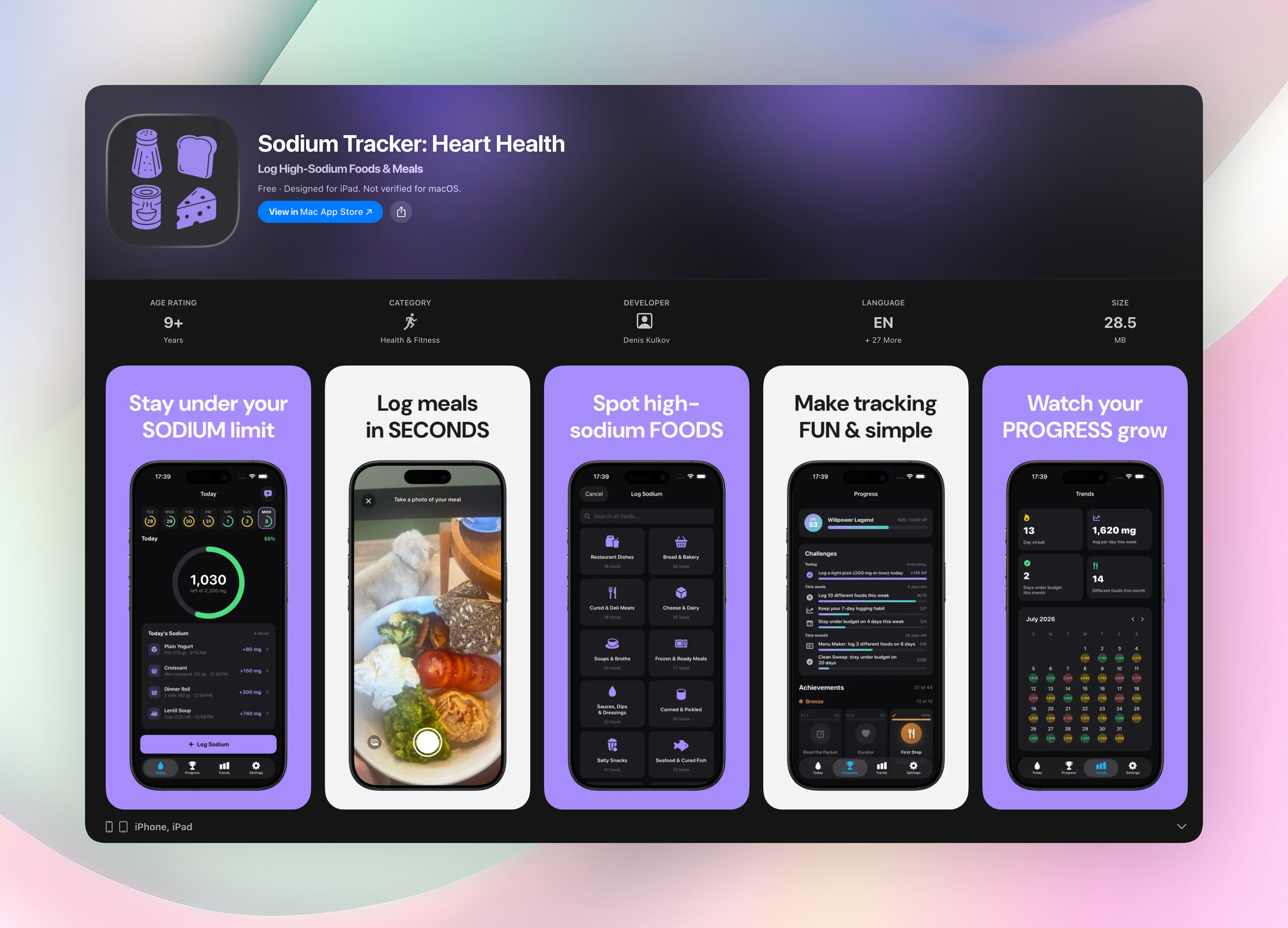
Sodium Tracker keeps things focused. Choose a daily limit based on FDA, AHA, or WHO guidance, then log the foods that contribute to your sodium intake. You can view sodium in milligrams or salt in grams, which is handy when you want to match the format used on nutrition labels.
A progress ring shows how much of your daily limit remains. The weekly calendar helps you spot patterns over time. You can add foods from a high-sodium food library or use a photo, barcode, or voice entry with AI assistance. You review each result before saving it.
The app works on iPhone and iPad. Its narrow focus is useful if an all-in-one nutrition dashboard makes sodium easy to miss. Everything runs on your device, with no account, ads, or data collection.
Standout features:
- Daily limits based on recognized health guidance
- Fast logging for common high-sodium foods
- Progress ring for an at-a-glance daily check
- Sodium and salt measurements
- Weekly streak calendar
Get Sodium Tracker or find Sodium Tracker on the App Store.
2. Nutrient Logger - Food Tracker
Best for: Detailed offline-first nutrient tracking on iPhone and iPad.
Nutrient Logger - Food Tracker covers calories, macros, vitamins, minerals, amino acids, and more than 80 nutrients. You can set goals or upper limits for individual nutrients instead of relying only on a calorie target. Its biggest advantage is offline-first logging, which works well if you want your food diary available without a constant internet connection.
3. Vitamin Tracker AI: Nutrition
Best for: AI-assisted meal and supplement tracking.
Vitamin Tracker AI: Nutrition reports 23 nutrients, including vitamins, minerals, macros, and fiber. It uses USDA FoodData Central data and includes daylight-exposure tracking, nutrient targets, and progress views. AI-assisted logging covers meals and supplements, so you do not have to enter every item by hand.
4. Microgram: Nutrient Tracker
Best for: Flexible food entry and broad micronutrient coverage.
Microgram: Nutrient Tracker monitors calories and more than 50 nutrients, including amino acids, fiber, and omega-3 and omega-6 fats. Food can be added with a photo, voice, text, barcode, or manual search. That variety is useful if repetitive food entry is what usually makes you stop tracking.
5. Cronometer: Calorie Counter
Best for: Android users who want extensive nutrient and compound tracking.
Cronometer: Calorie Counter covers calories, macros, fasting, and more than 95 nutrients and compounds. It includes a verified food database, barcode scanner, personalized targets, and nutrient trend reports. The database and detailed reports make it a better choice than a basic calorie diary for users who want a wider view of their nutrition.
6. Calorie Counter - MyNetDiary
Best for: Android users who want detailed tracking with quick-entry tools.
Calorie Counter - MyNetDiary can track up to 108 nutrients, including vitamins, minerals, omegas, and amino acids. It supports barcode scans, nutrition-label scans, voice logging, recipes, and progress charts. The label scanner is especially useful if most of your meals come from packaged foods.
7. Calorie Counter App: Fooducate
Best for: Shoppers comparing packaged foods in a store.
Calorie Counter App: Fooducate tracks calories, macros, selected micronutrients, workouts, water, and weight. Scan a barcode to review nutrition and ingredients, see a food grade, and find suggested alternatives. The grading system gives shoppers a fast way to compare similar products while they are in the store.
8. Lifesum: Calorie Counter
Best for: Users who want nutrition tracking alongside meal plans and recipes.
Lifesum: Calorie Counter supports photo, voice, text, and barcode logging for calories and macros. It also tracks water and food groups, then adds personalized recommendations, meal plans, and recipes. The mix of logging and planning tools suits people who want help deciding what to eat next, not just a record of what they already ate.
9. My-Nutri-Diary
Best for: Customizable daily or weekly nutrition goals.
My-Nutri-Diary records calories, macros, sugar, fiber, salt, food quality, allergens, and other dietary details. Its diet-planning tools and flexible targets can work with different eating patterns instead of pushing everyone toward one preset goal. Customizable weekly goals are particularly useful for people focused on longer-term monitoring.
How we picked these apps
This selection focuses on practical nutrients alternatives, including apps that can replace or supplement a broad nutrition tracker for a specific need. We compared coverage of sodium, vitamins, minerals, amino acids, fiber, fats, calories, macros, and other dietary measures.
We also considered how quickly you can record food. Barcode and nutrition-label scans, voice, photos, text, manual search, and offline access all matter when an app needs to fit into a busy day.
Finally, we looked at targets, upper limits, progress charts, trend reports, meal planning, food-quality guidance, and platform availability. iPhone and Android support are listed separately, so you can quickly rule out apps that do not work on your device.
Frequently asked questions
What should I look for in a nutrients alternative?
Start with your main goal: sodium tracking, full micronutrient coverage, calorie control, or meal planning. Compare database breadth with logging speed and likely accuracy. Then check platform support and whether the app lets you set useful goals or upper limits.
Is Sodium Tracker useful if I already track calories?
Yes. Sodium Tracker adds focused salt and sodium monitoring without requiring a complete nutrition diary. Its daily-limit choices and progress ring keep your attention on one nutrient, making it a good fit when sodium, rather than calories, is your main concern.
Are nutrient tracker apps accurate?
Results depend on the food database, serving sizes, label data, and how consistently you record meals. Check packaged-food labels when possible, and treat app targets as general guidance rather than a replacement for advice from a qualified clinician.
Which app is best for Android users?
Cronometer is the strongest choice for broad nutrient coverage, while MyNetDiary is better for nutrition-label scanning. Fooducate suits product comparisons, Lifesum adds meal plans and recipes, and My-Nutri-Diary offers customizable goals. Choose based on the nutrients you actually need to monitor.
The verdict
Sodium Tracker is the top pick for anyone whose main goal is tracking sodium or salt without sorting through an oversized nutrition dashboard. Its daily-limit choices, quick food logging, and progress ring make regular checking simple.
The other nutrients alternatives cover more ground, including vitamins, minerals, macros, meal planning, and packaged-food analysis. For focused sodium monitoring on iPhone or iPad, Get Sodium Tracker.
Free Sodium tools
- Banana Potassium CalculatorEnter a banana size and quantity to see total potassium in milligrams, its share of an adult daily target, and how it compares with other potassium-rich foods.
- Blood Pressure Category ChartUse this blood pressure chart by age and gender to place an adult reading in the AHA category it reaches. Age and sex do not change the adult thresholds.
- Daily Potassium CalculatorEstimate how much potassium per day you need and compare that target with foods eaten today.
- Daily Sodium Limit CalculatorEnter your age and a guideline to see how much sodium per day it recommends, plus the equivalent amount of table salt and a comparison with average US intake.
- DASH Diet Food ListSearch a DASH diet food list by food group, serving target and sodium preference. Review each food’s placement, serving context and sodium notes.
- DASH Diet Grocery List BuilderChoose your household size, days of meals, DASH food groups and sodium preference to build a printable grocery list.
- DASH Diet Meal PlannerPick your calorie level, your sodium target and how many meals you eat. The planner shows the published DASH daily serving targets for that calorie level and divides them — along with your sodium budget — across your meals.
- High-Sodium Foods ChartFilter a chart of high sodium foods by category and serving size. See sodium per serving and its percentage of the 2,300 mg daily limit.
- Low-Sodium Foods Reference ToolFilter a fixed list of foods low in sodium by category, serving size and sodium threshold.
- MAP Blood Pressure CalculatorEnter systolic and diastolic readings to estimate mean arterial pressure, see the published MAP reference band, calculate pulse pressure and identify the AHA category for the raw reading.
- Milligrams to Grams ConverterConvert milligrams to grams and between micrograms, milligrams, grams, kilograms, ounces and pounds. See the result written out and compare common nutrition-label values.
- Salt to Sodium ConverterConvert between salt and sodium units instantly. See grams of salt, milligrams of sodium, teaspoons of salt and the share of the 2,300 mg daily limit.
- Sodium Per-Meal Budget CalculatorTurn a daily sodium goal into an even meal-by-meal budget, then adjust it after reserving sodium for snacks.